
What Is a Planetary Gearbox?
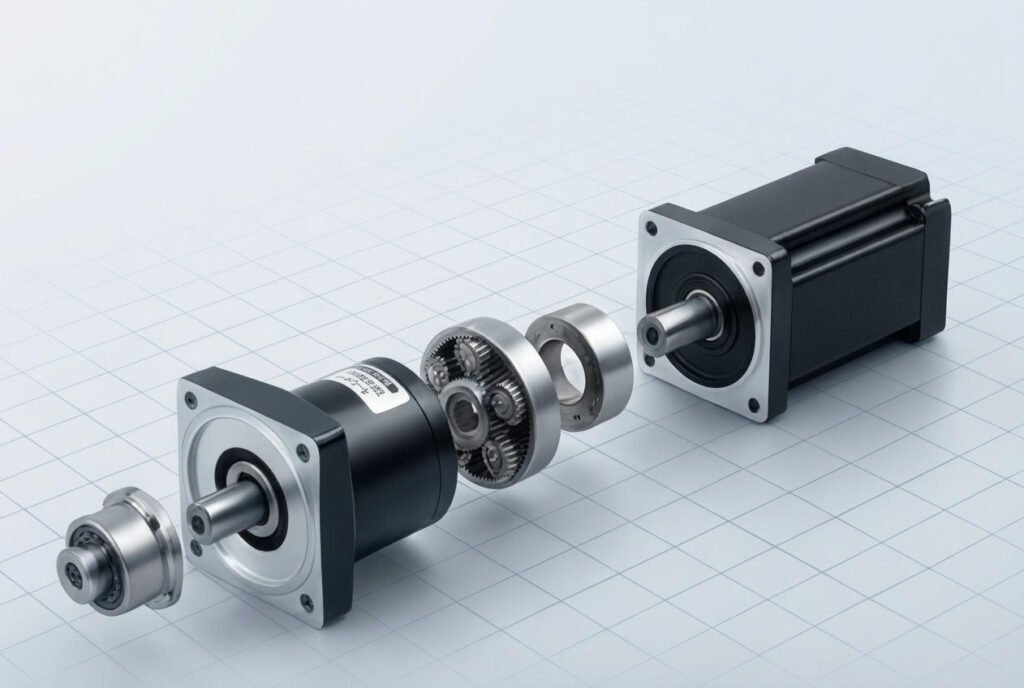
A precision planetary gearbox, also known as a precision planetary gear reducer, is a mechanical transmission system that uses a planetary gear arrangement to reduce rotational speed and increase torque.
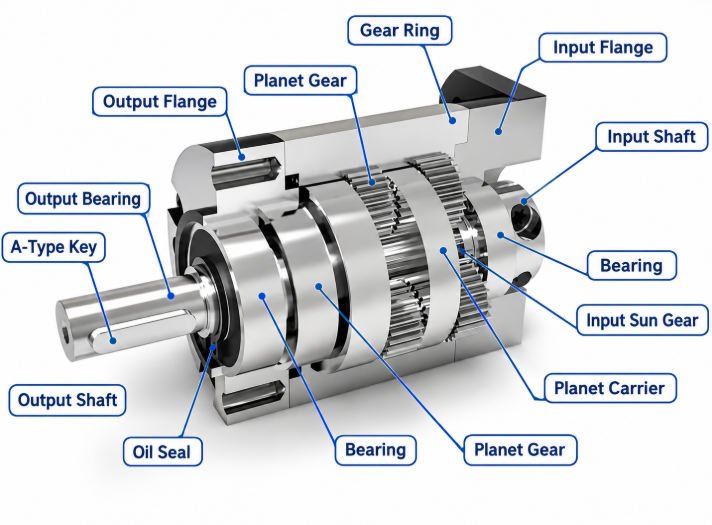
The gearbox consists of a central sun gear, multiple planet gears, an internal ring gear, and a planet carrier. These components work together to distribute torque across several gear meshes, providing high load capacity and efficient power transmission.
The term “precision” refers to its ability to deliver accurate rotational motion with minimal backlash, high torsional stiffness, and consistent positioning performance.
Precision planetary gearboxes are commonly connected to servo motors, stepper motors, and other electric motors. They help motors operate within the required speed and torque range while maintaining accurate motion control.
How Does a Precision Planetary Gearbox Work?
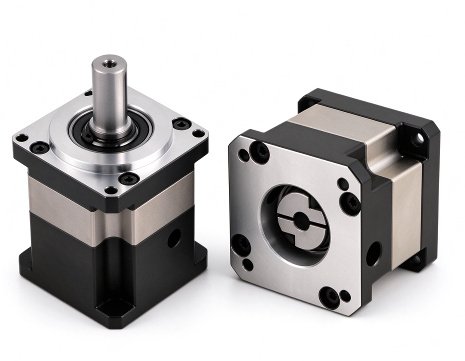
A precision planetary gearbox operates through the interaction of several gears arranged around a central sun gear.
The motor drives the sun gear, which transfers rotational motion to the surrounding planet gears. The planet gears rotate around their own axes while also revolving around the sun gear. Their motion is guided by the planet carrier and controlled by the internal ring gear.
Depending on the gearbox configuration, the ring gear may be fixed, the carrier may serve as the output, or another component may be used as the input or output.
Main Components of a Planetary Gearbox
A planetary gearbox contains several essential components. Each plays a specific role in power transmission, load distribution, and operational stability.
1.Sun Gear
The sun gear is located at the center of the planetary gear system. It is typically connected to the motor shaft and transfers input power to the planet gears.
2. Planet Gears
Planet gears rotate around the sun gear and engage with both the sun gear and the internal ring gear. Multiple planet gears distribute the transmitted load, increasing torque capacity and improving load balance.
3. Planet Carrier
The planet carrier supports the planet gears and transfers their combined rotational motion to the output shaft. In many standard planetary gearboxes, it is the output component.
4. Internal Ring Gear
The ring gear is positioned around the planet gears and features internal teeth. In a common planetary reduction arrangement, the ring gear remains fixed while the sun gear rotates and the planet carrier delivers the reduced-speed output.
Key Features of a Precision Planetary Gearbox
Precision planetary gearboxes are designed to deliver accurate, stable, and efficient mechanical transmission. Their main features distinguish them from standard industrial gear reducers.
1. Low Backlash
Backlash refers to the angular clearance between meshing gear teeth. Excessive backlash can cause positioning errors, vibration, and reduced motion control accuracy.
A precision planetary gearbox is manufactured with carefully controlled gear tolerances and optimized assembly processes to minimize backlash.
Low-backlash planetary gearboxes are particularly important in robotic joints, CNC machines, and servo-driven positioning systems.
2. High Torque Density
The planetary gear arrangement distributes loads across multiple planet gears. This allows the gearbox to transmit high torque without requiring a large housing.
As a result, precision planetary gear reducers provide excellent torque capacity relative to their size and weight.
3. High Transmission Efficiency
Precision planetary gearboxes generally achieve high mechanical efficiency because of their optimized gear geometry and multiple load-sharing gear meshes.
Depending on the design, lubrication, and reduction ratio, single-stage efficiency can often reach approximately 95% to 98%.
High efficiency reduces energy losses, heat generation, and operating costs.
4. High Torsional Stiffness
Torsional stiffness describes a gearbox’s resistance to twisting under applied torque.
A high-stiffness planetary gearbox helps maintain positioning accuracy when the system experiences changing loads. This is particularly important in servo applications that require precise acceleration, deceleration, and motion control.
5. Compact and Lightweight Design
The coaxial arrangement of the input and output shafts allows planetary gearboxes to achieve a compact structure.
This design is advantageous for equipment with limited installation space, including robotic arms, automated machinery, and compact industrial systems.
6. Long Service Life
Precision planetary gearboxes use high-quality gears, bearings, and housing materials to support continuous operation.
Proper lubrication, correct installation, and operation within the specified load limits can significantly extend gearbox service life.
Types of Planetary Gearboxes
Planetary gearboxes are available in different designs to meet specific torque, speed, precision, and installation requirements.
1. Single-Stage Planetary Gearbox
A single-stage planetary gearbox contains one planetary gear set.
It is generally suitable for applications requiring moderate speed reduction, compact dimensions, and reliable torque transmission.
Common applications include conveyor drives, small automation systems, and general industrial machinery.
2. Multi-Stage Planetary Gearbox
A multi-stage planetary gearbox combines two or more planetary gear sets to achieve a higher overall reduction ratio.
The overall ratio is the product of the individual stage ratios. For example, two stages with ratios of 4:1 and 5:1 provide a nominal overall reduction ratio of 20:1.
Multi-stage designs are suitable for applications requiring high torque at relatively low output speeds. However, additional stages can increase gearbox length, complexity, and power losses.
3. Precision Planetary Gearbox
A precision planetary gearbox is designed for applications that require accurate positioning, controlled motion, and low backlash.
It is commonly used with servo motors and stepper motors in robotics, CNC machinery, and automated production equipment.
Key selection factors include backlash, torsional stiffness, transmission accuracy, and permissible radial and axial loads.
4. Right-Angle Planetary Gearbox
A right-angle planetary gearbox uses an additional transmission arrangement to change the direction of power transmission, commonly by 90 degrees.
It can be useful when installation space or shaft orientation makes an inline configuration unsuitable. Its construction and efficiency depend on the additional gear mechanism.
Planetary Gearbox vs. Conventional Gearbox
Precision planetary gearboxes and standard planetary gearboxes share the same basic operating principle, but they are designed for different performance requirements.
| Feature | Precision Planetary Gearbox | Standard Planetary Gearbox |
|---|---|---|
| Backlash | Low and controlled | Generally higher |
| Positioning accuracy | High | Moderate |
| Torsional stiffness | High | Application-dependent |
| Manufacturing tolerances | Tighter | Less stringent |
| Transmission efficiency | Generally high | Design-dependent |
| Cost | Higher | Lower |
| Main applications | Servo systems, robotics, CNC | General power transmission |
Precision planetary gearboxes are preferred when motion accuracy and repeatability are essential. Standard planetary gearboxes are more suitable for applications where torque transmission and cost efficiency are the primary priorities.
Types of Precision Planetary Gearboxes
1. Inline Precision Planetary Gearbox
An inline planetary gearbox features coaxial input and output shafts. Its compact design provides efficient power transmission and easy integration with servo motors.
Typical applications:
- CNC machine tools
- Industrial robots
- Automated production lines
- Precision positioning systems
2. Helical Precision Planetary Gearbox
A helical precision planetary gearbox uses helical gears with angled teeth. Compared with straight-tooth designs, helical gears can provide smoother engagement, lower noise, and improved load distribution.
They are suitable for applications requiring quiet operation and high precision.
3. Right-Angle Planetary Gearbox
A right-angle planetary gearbox changes the direction of power transmission, typically by 90 degrees.
It is ideal for machinery where installation space is limited or the motor cannot be mounted in line with the output shaft.
4. Multi-Stage Precision Planetary Gearbox
A multi-stage planetary gearbox contains two or more planetary gear stages connected in series.
Each stage increases the overall reduction ratio, allowing the gearbox to achieve higher torque and lower output speed.
Multi-stage configurations are widely used in heavy-duty positioning systems and industrial automation.
Common Applications of Planetary Gearboxes
Robotics and Collaborative Robots
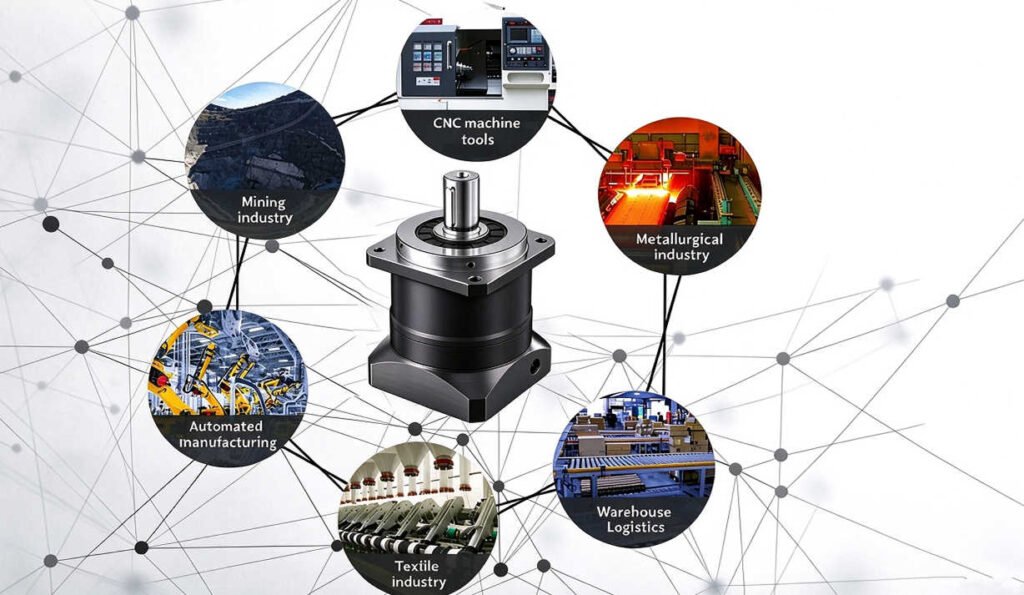
Robot joints require gearboxes that can hold position rigidly under varying loads while introducing minimal lost motion. In a multi-joint arm, backlash at each joint accumulates through the kinematic chain, so even a few arcminutes at each axis can produce significant error at the end effector. Precision planetary gearboxes are used in the main rotation and bending axes of articulated robots, the slim arms of collaborative robots, and the Z and R axes of SCARA robots. Flange output configurations allow direct integration into joint housings, eliminating couplings and their associated compliance.-11
CNC Machine Tools and Precision Machining
In CNC feed axes, tool changers, and rotary tables, backlash directly affects surface finish and dimensional accuracy. When the machine reverses direction during contouring or circular interpolation, any lost motion in the drive train creates a visible mark on the workpiece. Precision planetary gearboxes with low backlash and high torsional rigidity minimize these errors, enabling higher machining accuracy and faster cycle times.-7
Semiconductor and Electronics Manufacturing
Wafer handling systems, die bonders, wire bonders, and inspection equipment demand smooth, precise motion with minimal vibration. Precision planetary reducers are used in wafer conveyor belts, indexing rotary tables, and pre-aligners, where their high torque density and compact form factor fit within the tight space constraints of cleanroom equipment. The low backlash of these gearboxes supports the repeatable positioning required for micron-level processing.-3
Medical and Laboratory Equipment
From CT and MRI gantry rotation to surgical assistance mechanisms and diagnostic instruments, precision planetary gearboxes provide quiet, smooth motion with the reliability required in clinical environments. The low noise and low vibration characteristics of well-manufactured precision units are particularly important in imaging equipment, where vibration can degrade image quality.-7
Packaging and High-Speed Automation
High-throughput packaging machines and pick-and-place systems operate at rapid cycle rates with frequent direction changes. Precision planetary gearboxes enable fast acceleration and deceleration without sacrificing positioning accuracy, helping to maximize throughput while maintaining product quality.
Renewable Energy and Heavy Industry
Certain wind turbine drivetrains and industrial heavy-duty systems use planetary gear stages to manage speed and torque. Suitability depends on the load profile, power rating, design requirements, and maintenance strategy.
How to Choose the Right Planetary Gearbox
Selecting the correct planetary gearbox is essential for achieving reliable performance and a long service life.
1. Determine the Required Torque
Calculate the torque needed by the driven equipment, including starting torque, acceleration requirements, peak loads, and operating conditions.
Do not select a gearbox based only on its nominal torque if the application involves frequent starts, shocks, or overloads.
2. Calculate the Gear Ratio
The gear ratio determines the relationship between input speed and output speed.
For a reduction gearbox:
Output speed = Input speed / Gear ratio
For example, a motor running at 1,500 rpm connected to a 10:1 reduction gearbox produces a nominal output speed of approximately 150 rpm.
Actual output speed may vary with motor speed and operating conditions.
3. Check Motor Compatibility
Confirm that the gearbox can be mounted to the selected motor. Important details include motor flange dimensions, shaft diameter, coupling arrangement, and allowable input speed.
For servo systems, verify the gearbox’s compatibility with the motor’s rated torque, peak torque, and dynamic performance requirements.
4. Consider Backlash and Accuracy
Backlash is the angular movement between mating gear components when the direction of applied torque changes.
Applications involving precision positioning may require a low-backlash planetary gearbox. General industrial drives may accept higher backlash if positioning accuracy is not critical.
5. Evaluate Operating Conditions
Consider ambient temperature, dust, moisture, vibration, installation orientation, duty cycle, and available maintenance access.
For demanding environments, review the housing protection, sealing system, lubricant specifications, and permissible operating temperature.
6. Review Service Life and Total Cost
Compare the expected service life, maintenance needs, warranty, spare parts availability, and manufacturer support.
A gearbox with a lower initial price may not be the most economical option if it has a shorter service life or cannot meet the required operating conditions.
Frequently Asked Questions About Planetary Gearboxes
What is the main purpose of a planetary gearbox?
The main purpose is to adjust rotational speed and torque in a compact transmission system. A reduction configuration decreases output speed and generally increases available output torque, subject to mechanical losses.
Is a planetary gearbox more efficient than a worm gearbox?
Planetary gearboxes can offer higher efficiency than many conventional worm gearboxes, particularly in well-designed reduction stages. However, the actual comparison depends on the gear ratio, load, speed, lubrication, and specific product design.
Can a planetary gearbox be used with a servo motor?
Yes. Precision planetary gearboxes are commonly paired with servo motors in robotics, CNC machines, and automation systems. The gearbox ratio, backlash, stiffness, torque rating, and motor interface must match the application.
H3: How long does a planetary gearbox last?
Service life depends on load, operating speed, lubrication, temperature, installation accuracy, maintenance, and manufacturing quality. Follow the manufacturer’s rated-life and maintenance guidance rather than relying on a universal service-life estimate.
How do I choose a planetary gearbox manufacturer?
Evaluate the manufacturer’s engineering capabilities, product range, technical documentation, quality-control procedures, customization options, delivery lead times, and after-sales support. Request performance data and confirm that the proposed gearbox meets your operating requirements.